
Patio Drainage: Where Does the Water Actually Go?
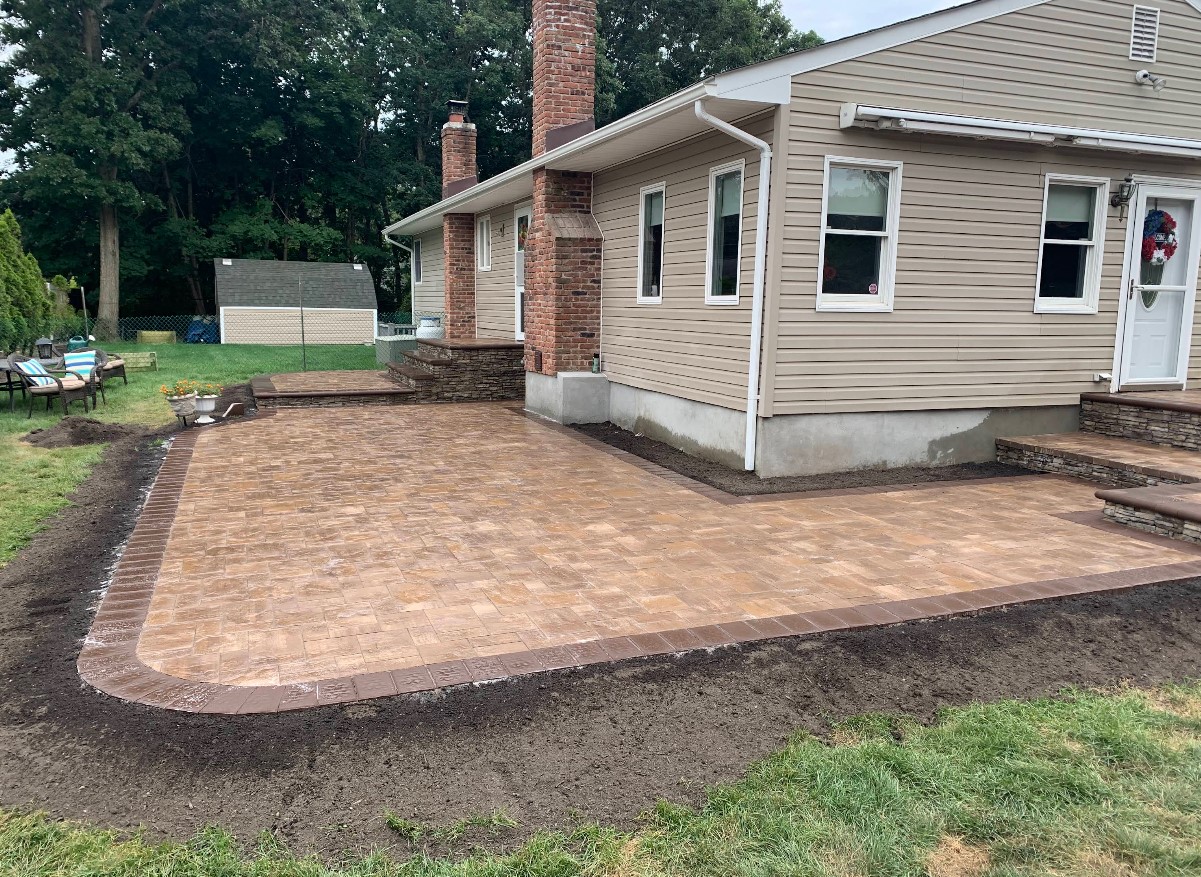
Every square foot of patio is a square foot of ground that no longer absorbs rain. The water doesn’t disappear. It goes somewhere, and if nobody decided where, it decides for itself.
That decision is the difference between a patio and a problem.
Start with the arithmetic
A patio is a collection surface. A decent-sized one gathers a meaningful volume of water in a heavy Long Island storm and delivers all of it to whatever is downhill.
Three questions, in order:
1. Which way does it fall? 2. Where does the water arrive? 3. Can that place absorb it?
Most patio drainage failures are a failure of question three. The falls are fine, the water leaves the patio correctly, and it arrives somewhere that was already saturated.
Pitch: the number that matters
A patio should fall away from the house at roughly a quarter of an inch per foot.
Less than that and it doesn’t reliably shed. Paving is not perfectly flat, small variations are normal, and a shallow pitch means water sits in the low spots rather than running off. On a Long Island winter, standing water at the back door is an ice sheet in January.
Much more and you feel it. Furniture rocks, drinks lean, and it reads as a mistake.
It must be consistent. A patio that falls correctly for two-thirds of its length and then flattens creates a puddle exactly where the pitch stops. This is set-out work, done with a level before anything is laid: not something adjusted at the end.
On flat ground it’s harder, not easier. South-shore towns on the outwash plain, Islip, Sayville, Patchogue, Holbrook, Medford, have no natural fall to work with, so every inch of pitch has to be built in deliberately. On a sloping north-shore site the ground does some of the work for you.
Away from the house, always
The single most consequential rule on this page.
Water running back toward the building stops being a patio problem and becomes a sill, framing and foundation problem. It is also the most common serious defect we’re called to look at on existing patios: usually because the patio was built up to meet an existing door threshold without the fall being set first.
Watch for: water marks on the wall, a damp line inside, staining on the paving nearest the house, or ice forming against the building.
If your patio pitches toward the house, that is a fix-it-now item rather than a next-year item.
Where the water should go
Onto lawn or planting. The simplest answer and usually the best. Turf and soil absorb water, and if there’s somewhere for the runoff to spread out and soak in, you’re done. Works well on free-draining outwash sand across central and southern Suffolk.
Into a dry well. A buried chamber surrounded by aggregate that collects runoff and lets it percolate into the ground. Effective, invisible, and it depends entirely on the ground being able to accept water, which is the catch on north-shore moraine till, where a dry well in slow-draining ground fills up and stays full.
Into a French drain. A perforated pipe in a gravel trench that intercepts water and carries it somewhere else. Good for moving water away from a specific problem area, and it still needs a destination.
Into a channel drain. A slot drain across a threshold or at the low edge of a patio, catching water in a line rather than a point. The usual answer where a patio meets a garage or a door and there’s no room to pitch away.
Not onto your neighbour’s property. Beyond being poor practice, concentrating and directing runoff onto adjoining land can create liability. Worth being careful about, and worth raising before it’s built rather than after the first storm.
Permeable paving
Worth understanding, because it’s the option most people haven’t heard of.
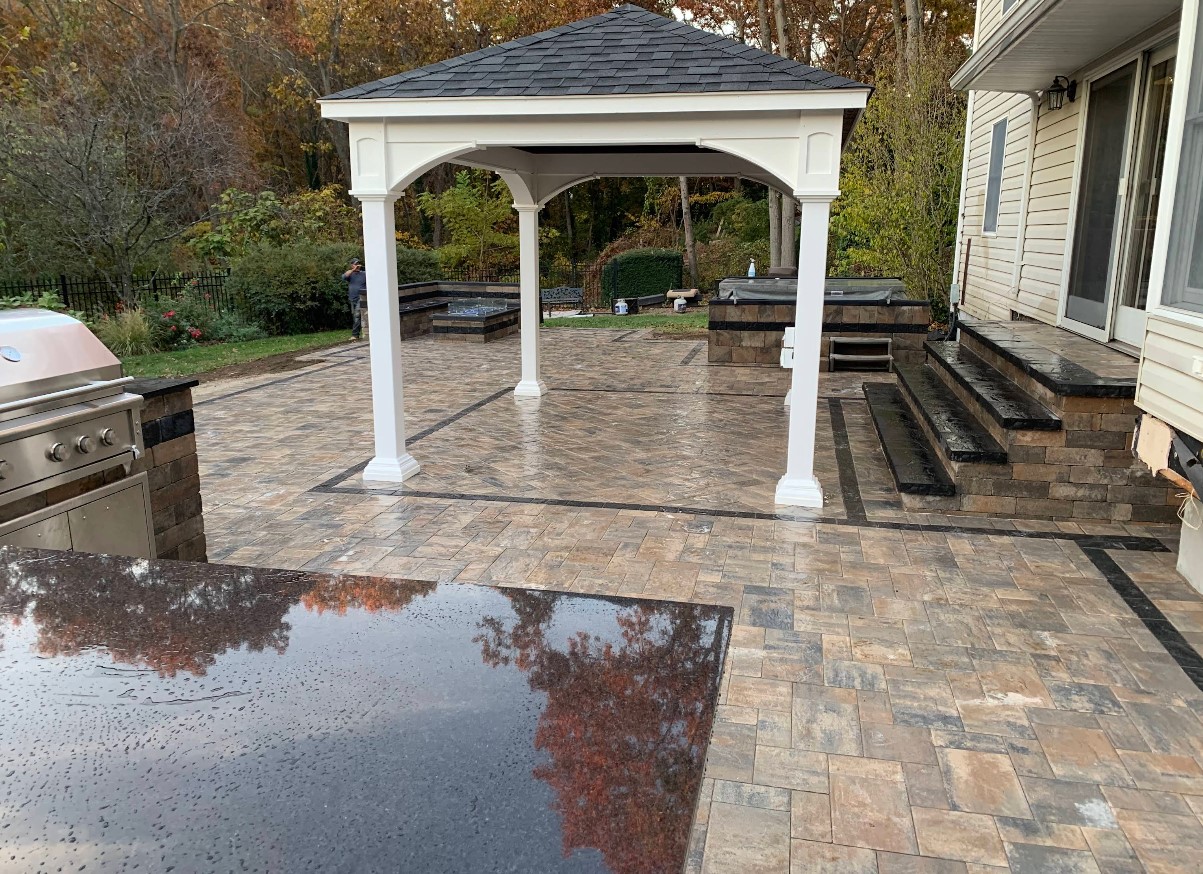
Permeable paver systems let water pass through the surface rather than running off it. The joints are filled with open-graded aggregate rather than sand, and the base is an open-graded stone reservoir that holds water and lets it percolate into the ground.
Where it’s genuinely good: free-draining ground with no room to send runoff anywhere. Suffolk’s outwash sand is close to ideal. The water goes down rather than sideways. It also helps where lot coverage or impervious-surface limits are a constraint, since some jurisdictions treat permeable systems differently from solid ones.
Where it isn’t: on moraine till that won’t accept water. A permeable system over ground that can’t percolate is a reservoir with nowhere to empty.
The trade-offs: a deeper base, higher cost, and the joints need maintaining. They can clog with fine silt over years and periodically need vacuuming or refreshing to keep working.
Where you are decides the answer
Outwash plain: Medford, Holbrook, Patchogue, Sayville, Islip. Free-draining sand. Dry wells work, permeable systems work, and getting water into the ground is straightforward. The constraint is that flat lots have no natural fall, so pitch has to be built.
Moraine: Huntington, Commack, Setauket, Port Jefferson, Miller Place, Ronkonkoma. Till that holds water. Getting it into the ground is the hard part, so drainage here is usually about moving water to somewhere rather than into the ground where it lands. Sloping sites help with the moving and complicate the destination.
Coast and bayside: Hampton Bays, and the low streets of Islip, Sayville and Patchogue. A high water table limits how much the ground can accept, and flood-zone rules can apply.
What we do about it
Drainage is designed before the patio is, because everything else follows from it. We’ll look at where the water currently goes, where it needs to go, and what’s downhill of it: including what happens in a heavy storm rather than an average one.
If your existing patio puddles, ices over, or sends water at the house, send a photograph after rain. That picture tells us most of what we need to know.
Book a free on-site estimate → · Call (631) 245-9273
Related
Patio installation in Suffolk County · How a paver patio is built · Patio repair and restoration