
How Long Does an Asphalt Driveway Last?
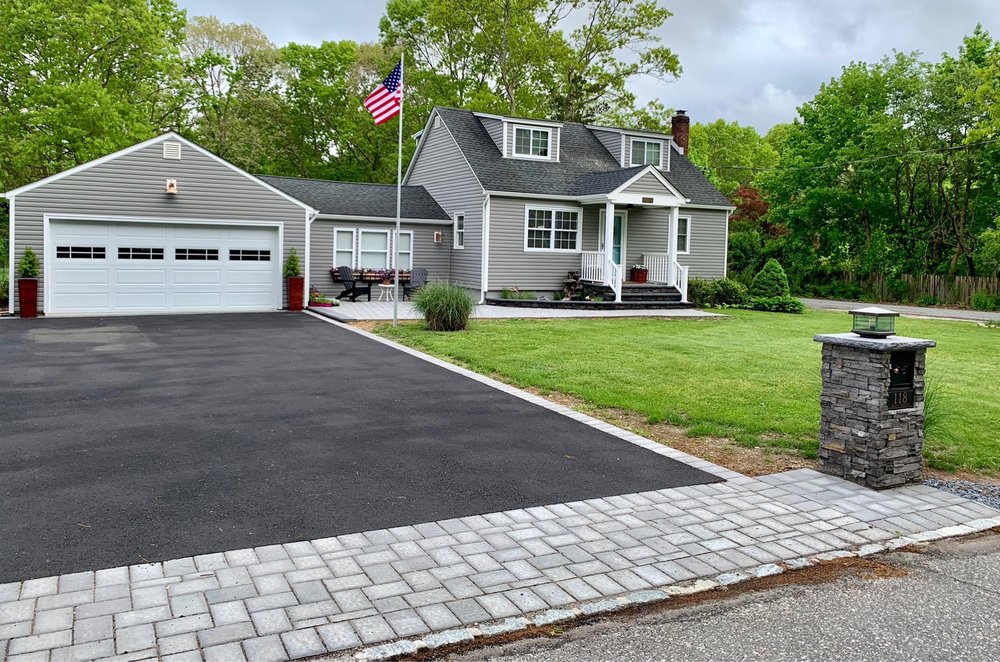
That span is wide, and the width is the point. It’s the difference between a driveway that was built properly and one that wasn’t.
Almost everything that determines where a driveway lands in that range was decided before the asphalt went down.
What was decided before you owned it
Base depth and compaction. The aggregate under the surface carries the load. A driveway on a shallow or poorly compacted base is on a clock from day one, and no amount of aftercare resets it. This is the single biggest determinant and it’s entirely invisible.
Whether it was excavated. New asphalt laid over an old failed surface inherits everything wrong with it.
Compaction of the asphalt itself. Hot mix has to be rolled while hot enough to reach density. Asphalt that cooled too far before compaction has too much air in it, water gets in, and it ravels early: usually starting at the edges, which cool fastest.
Drainage. Water under a driveway through a freeze-thaw winter is the mechanism behind most premature failure on Long Island.
What’s actually in an asphalt driveway →
What the ground does to it
Suffolk County gives a driveway two different ways to fail depending on which side of the glacial moraines it sits on.
South of them: Medford, Holbrook, Patchogue, Sayville, Islip. Free-draining outwash sand. The failure is settlement: loose sand consolidating under repeated vehicle load where the base wasn’t compacted in lifts. It shows as a dished area where the cars park, and it develops gradually over the first few years.
On the moraine: Huntington, Commack, Setauket, Port Jefferson, Miller Place, Ronkonkoma. Unsorted till that holds water. The failure is frost heave: water freezing under the surface and lifting it. It shows as a crack that returns in exactly the same place every spring.
On the coast: Hampton Bays. Free-draining sand plus a high water table near the water, limiting how deep the base can go.
A driveway built for the wrong one of these will be at the short end of the range whatever else is done to it.
The four things that shorten it most
1. Standing water. Anywhere water sits, the surface degrades faster. Pooling is a symptom worth fixing rather than living with.
2. Fuel and oil. Petrol, diesel and engine oil dissolve the binder that holds asphalt together. A drip is nothing; a persistent leak softens a patch right through. This is asphalt’s specific vulnerability and it’s easily avoided.
3. Heavy vehicles. A skip lorry, a concrete truck or a moving van can do in one visit what years of cars won’t: especially on a driveway still curing in its first summer.
4. Edge damage. The perimeter has nothing beside it holding it up. Wheels running over an unsupported shoulder start a failure that works inward, and a plough blade dragged hard across the edge does the same. Both are avoidable.
What extends it
Fix cracks before winter. A crack wider than a pencil lets water to the base. Water in that crack freezing widens it every cycle. Filling it in October is cheap; not filling it is how a surface problem becomes a base problem.
Seal sensibly, and not too often. Sealer protects the binder from UV and oxidation, which is real. But a new driveway must cure before it’s sealed at all, and repeated coats build a brittle skin that cracks independently of the asphalt underneath. Less often than the flyers suggest.
Choose your de-icer. Asphalt is relatively tolerant of salt compared with concrete. Sand gives traction with no effect at all.
Keep the edges supported. Soil and turf built up to the shoulder. Mark the edges before the first snow so whoever ploughs can see where the surface stops.
Resurface at the right moment. An overlay on a sound base resets the surface for a fraction of replacement cost, and it works on the near side of base failure, not the far side.
Knowing when you’re near the end
A driveway rarely fails suddenly. It tells you, over several years, and the signals are readable.
Early: fine surface cracking, colour greying, slight ravelling. Sealing and crack filling territory. Years left.
Middle: cracks widening past pencil width, isolated dips, minor edge loss. This is the resurfacing window and it is the moment where the money goes furthest.
Late: interconnected alligator cracking, potholes, broad settlement, pooling. Base failure. Resurfacing now is money spent twice.
The mistake people make is waiting through the middle stage because the driveway still functions. It does: right up until the point where the cheap option is no longer available.
The full nine-symptom diagnostic →
Not sure where yours is?
Send a photograph of the worst area and one of the driveway after rain. That’s usually enough for us to tell you which stage you’re at, and whether it’s a this-year job or a five-years-away job.
Get in touch → · Call (631) 245-9273
Frequently Asked Questions
How long should an asphalt driveway last?
A professionally installed asphalt driveway generally lasts between 15 and 25 years, depending on maintenance, climate, and traffic.
How often should an asphalt driveway be sealed?
Most experts recommend sealcoating every 2 to 4 years to protect against moisture, sunlight, and everyday wear.
Can cold winters shorten an asphalt driveway’s lifespan?
Yes. Freeze-thaw cycles common in Suffolk County can cause water to expand inside cracks, leading to additional damage if maintenance is neglected.
Is asphalt better than concrete for New York homes?
Both materials have advantages, but asphalt is often preferred because it performs well in colder climates, is generally more affordable to install, and is easier to repair.
What is the best time of year to install an asphalt driveway?
Spring through early fall typically provides the ideal temperatures for asphalt driveway installation, allowing the material to cure and compact properly.
Related
Paving contractor in Suffolk County · Resurfacing or replacement? · Driveway aftercare and sealcoating · Driveway paving cost