
What’s Actually in an Asphalt Driveway
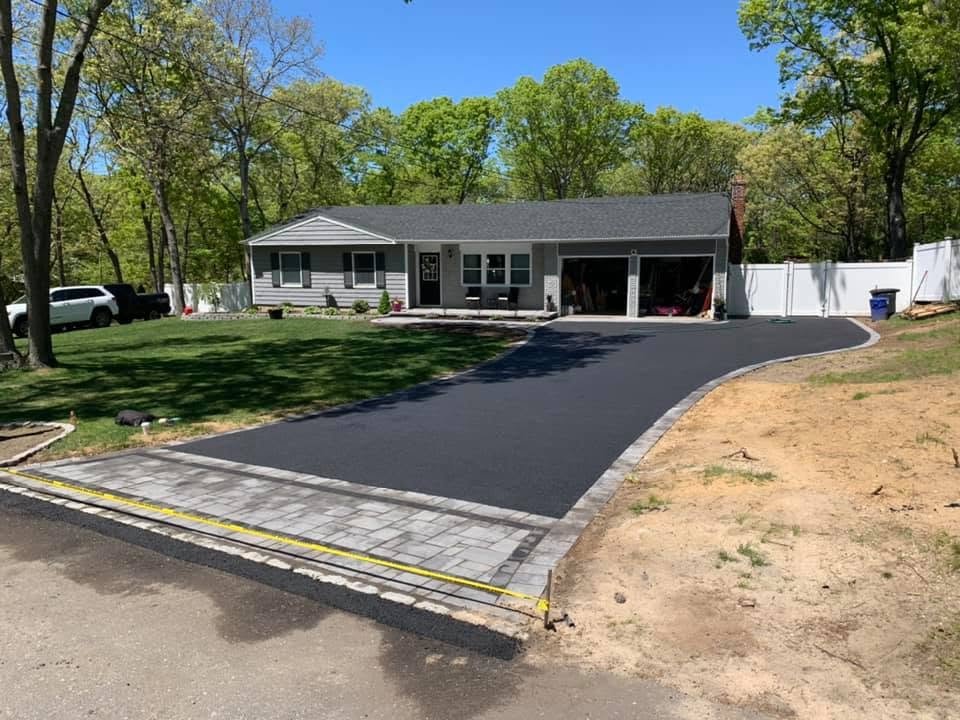
Most driveway quotes give you a price and a square footage. This page is so you can read the rest of it, or notice when there isn’t a rest of it.
A driveway is four things stacked: the subgrade, the base, the asphalt, and the compaction that holds it all together. Three of them are invisible once the job is finished, and they’re the three that decide how long it lasts.
1. The subgrade
The natural ground, once everything else is stripped off.
You don’t build the subgrade, you prepare it: excavate to depth, remove anything soft or organic, and compact what’s left. Topsoil and root material have to come out. They hold water, they decompose, and anything built on them settles.
This is where Suffolk County splits in two. On the outwash plain south of the moraines (Medford, Holbrook, Patchogue, Sayville, Islip) the subgrade is free-draining sand and gravel: easy to work, and it consolidates under load if it hasn’t been compacted properly. On the moraine (Huntington, Commack, Setauket, Port Jefferson, Miller Place, Ronkonkoma) it’s unsorted till that holds water, and the design problem is getting that water out from under the driveway rather than supporting loose material.
Same county, opposite problems, and it’s why a contractor’s answer to “what’s under this?” matters.
2. The aggregate base
Crushed stone, placed on the prepared subgrade and compacted.
This is the structural part of a driveway. The asphalt on top is a wearing surface and a weather seal; the base is what actually carries the vehicle load and spreads it out over the subgrade. A thick surface on a thin base is a driveway that will fail; a modest surface on a proper base will not.
Depth depends on the subgrade and on what the driveway carries. A car-only residential drive on good ground and one that takes a delivery truck on soft ground are different specifications, and any contractor giving you the same number for both without looking is quoting a habit rather than a job.
Compaction in lifts is the part that gets skipped. Aggregate has to go down in layers, with a compaction pass at each layer. A compactor can only densify so much material below it, so base placed at full depth and rolled once is properly compacted at the top and loose underneath. It looks identical on the day. It consolidates unevenly over the following two years, and that’s the dished-where-the-cars-park failure you see all over the south shore.
3. The asphalt
Hot mix asphalt is aggregate, stone and sand, graded to a specified distribution of sizes, bound together with asphalt binder, the black petroleum product that makes it stick.
The mix design matters more than people expect. A coarser mix is stronger and rougher; a finer mix is smoother and less durable under load. Which is why the top of a driveway and the layer under it are often not the same material.
Two courses, or one.
A binder course is the lower, coarser layer. It carries load and it’s where the structural strength of the asphalt sits.
A top course (or surface course) is the finer layer above it. It gives the smooth finish, sheds water, and takes the wear.
Some residential driveways are built as a single course, some as binder plus top. Two courses gives more total thickness and a better finish; one is adequate for lighter use on good ground. It should be stated on the quote either way, with the thickness of each.
Recycled content. Reclaimed asphalt pavement is routinely included in modern mixes, and that’s normal and fine at proportions the plant designs for. What isn’t fine is a driveway made entirely of milled reclaimed material laid cold, which is a different product presented as the same one.
4. Compaction, and the temperature window
This is the step with no visible evidence and the biggest consequence.
Hot mix asphalt is laid hot and rolled while it’s still hot. As it cools, the binder stiffens and the aggregate stops being able to move into place, so beyond a certain temperature the material simply cannot be compacted to density any more, regardless of how many passes a roller makes.
Asphalt that didn’t reach density has too much air in it. Air means water gets in, and water in a porous asphalt mat through a freeze-thaw winter is what causes ravelling: the surface losing aggregate and going rough, usually starting at the edges where the mat cooled fastest.
Practically, that means paving crews work quickly, they pave in warm enough weather, and they don’t lay material that’s been sitting in a truck too long. It’s the entire reason the paving season on Long Island runs spring through late autumn rather than year-round, and it is also why the “leftover asphalt from a job down the road” story is physically impossible.
The edges, and the pitch
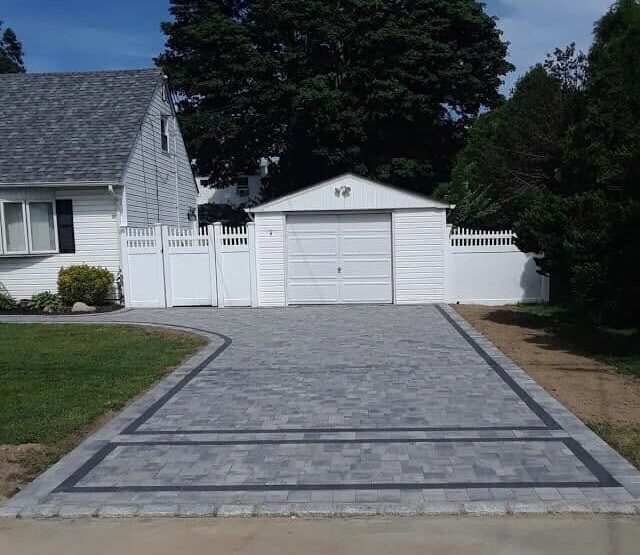
Edges are the most vulnerable part of a driveway, because the asphalt at the perimeter has nothing beside it holding it up. A proper shoulder, soil or aggregate built up to the edge, supports it. Without one, the edge crumbles as soon as a wheel runs over it, and once it starts it works inward.
Pitch should move water off the driveway and somewhere sensible. Not into the garage, not against the foundation, not across the boundary. On flat outwash-plain lots this is a set-out job done before anything is laid, because there’s no natural fall to rely on.
The four numbers to ask for
If you take one thing from this page, take these. Ask every contractor quoting your driveway:
1. Excavation depth: how deep are you digging? 2. Base material and compacted depth: what stone, how thick after compaction? 3. Compaction sequence: how many lifts, how many passes? 4. Asphalt specification: one course or two, and what thickness each?
Four short questions. Contractors who intend to build a proper driveway answer them immediately. It’s the fastest filter there is.
Get a written, itemised estimate → · Call (631) 245-9273
Related
Paving contractor in Suffolk County · What happens on paving day · Concrete vs asphalt · How long an asphalt driveway lasts