
Outdoor Kitchen Construction in Suffolk County, NY
From a built-in grill surround to a full cook line with counters, storage, refrigeration and a sink: built in non-combustible framing, faced to match your hardscaping, with the utilities planned before anything is enclosed.
Get a free on-site estimate → · Call (631) 245-9273
Decide the utilities before the masonry
An outdoor kitchen is a masonry job wrapped around a services job, and the services have to be resolved first. Once the carcass is built and faced, adding a gas line or a water run means opening it back up.
Gas needs a line sized for the appliance load, or a propane tank with somewhere accessible and ventilated to live. Electric needs outdoor circuits with GFCI protection and enough of them: under-counter refrigeration wants a dedicated supply and ventilation. A sink needs supply, drainage, and a way to be isolated and blown down before winter, because a line that can’t be drained will split in the first hard freeze.
The full utilities breakdown →
Non-combustible construction, and why it matters
The carcass is steel stud and cement board, or block. Not timber.
Every built-in grill has a required clearance envelope and required ventilation openings specified by its manufacturer. Build tighter than that and you have a void warranty and a genuine fire risk: around an appliance producing serious heat, enclosed in masonry, next to your house.
It is the part of an outdoor kitchen nobody sees and everybody should ask about. If a contractor can’t tell you the clearances for the grill you’ve chosen, they haven’t looked them up.
Sizing
Two measurements do most of the work.
Counter run either side of the grill. Somewhere for the raw food going on and the cooked food coming off. A grill with no landing space is the most common regret and it costs almost nothing to design in at the start.
Bar overhang and stool clearance. If people will sit at it, the overhang needs depth for knees and the stools need room to pull back behind whoever’s cooking.
Then: prevailing wind so smoke doesn’t blow into the seating; distance from the back door, because everything you forgot is in the indoor kitchen; and shade, because a cook line in full afternoon sun gets used far less than people expect.
Layouts and appliance choices →
Building for a Suffolk County winter, and a Hampton Bays one
Freeze-thaw applies everywhere here. Anything porous that takes on water and freezes will eventually spall, which rules out several countertop materials sold as suitable for outdoor use in milder climates.
Anything holding water must be drainable. Sink supply, any water line, the trap. Design it in; it’s a ten-minute job once a year and an expensive repair if it isn’t possible.
Salt matters near the coast: Hampton Bays especially, and the bayside parts of Sayville, Islip and Patchogue. Stainless grades that perform perfectly ten miles inland pit and streak in marine air within a couple of seasons. Appliances, doors, drawers and fixings all want specifying for it, and that decision is much cheaper made once at design stage than piece by piece afterwards.
Build it with the patio if you can
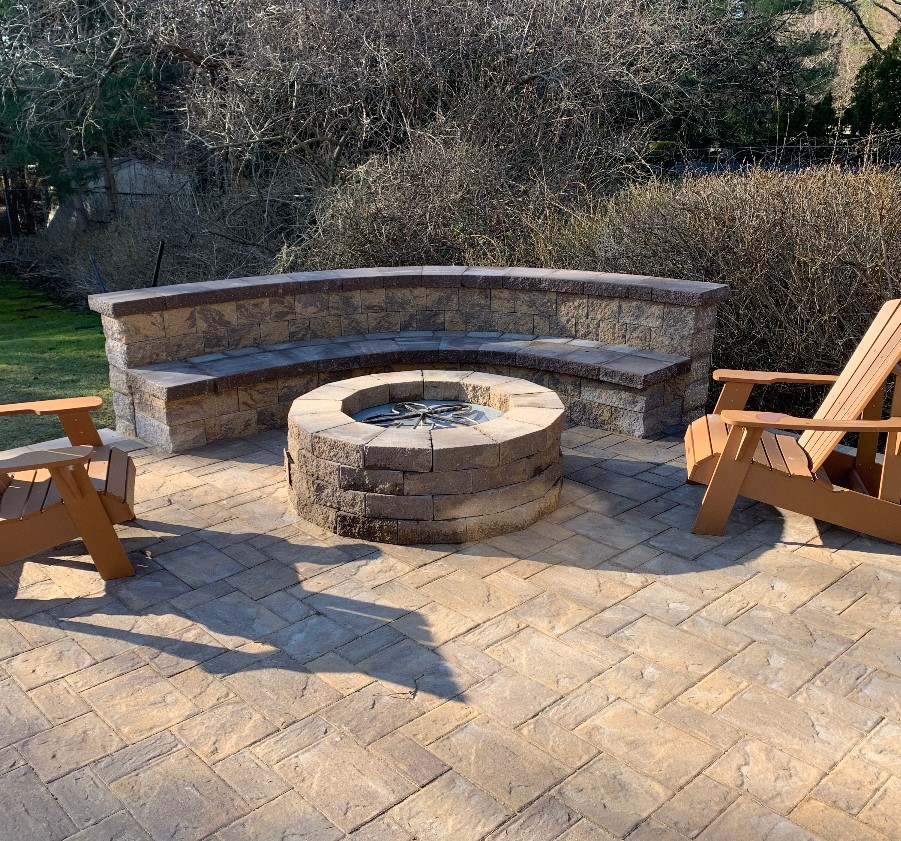
Gas, electric and water trenches go in before the paving. Base is continuous under the whole area. Materials come from one batch, so the kitchen facing and the patio actually match: concrete pavers vary between production runs and nothing fixes that later.
Retrofitting into an existing patio is entirely doable. It means lifting and relaying around the new footprint and trenching through finished work, which is a real cost line and one we’ll show you separately so you can weigh it.
Patios in Suffolk County → · Fire pits →
Where we build
Medford · Holbrook · Ronkonkoma · Patchogue · Sayville · Islip · Setauket · Port Jefferson · Miller Place · Commack · Huntington · Hampton Bays
Book a free on-site estimate → · More about us →
Frequently asked questions
Can I use my existing grill? A freestanding grill isn’t designed to be built into an enclosure: clearances and ventilation differ. Built-in units exist for this. We can design around a freestanding grill with counters either side instead.
Will it survive the winter? The masonry and a properly specified countertop will. Anything holding water has to be drained down. We’ll show you what and when.
What does it cost? It comes down to the size of the run, the materials, and which utilities have to reach it. We quote on site and the estimate is free, so you get a figure for your property rather than a national average. Book one, or call (631) 245-9273 if you want to talk it through first.
When should I build it? Autumn, for the following summer. The summer you want to use it is the summer everyone is booked. Seasonal guide →