
Retaining Wall Contractor in Suffolk County, NY
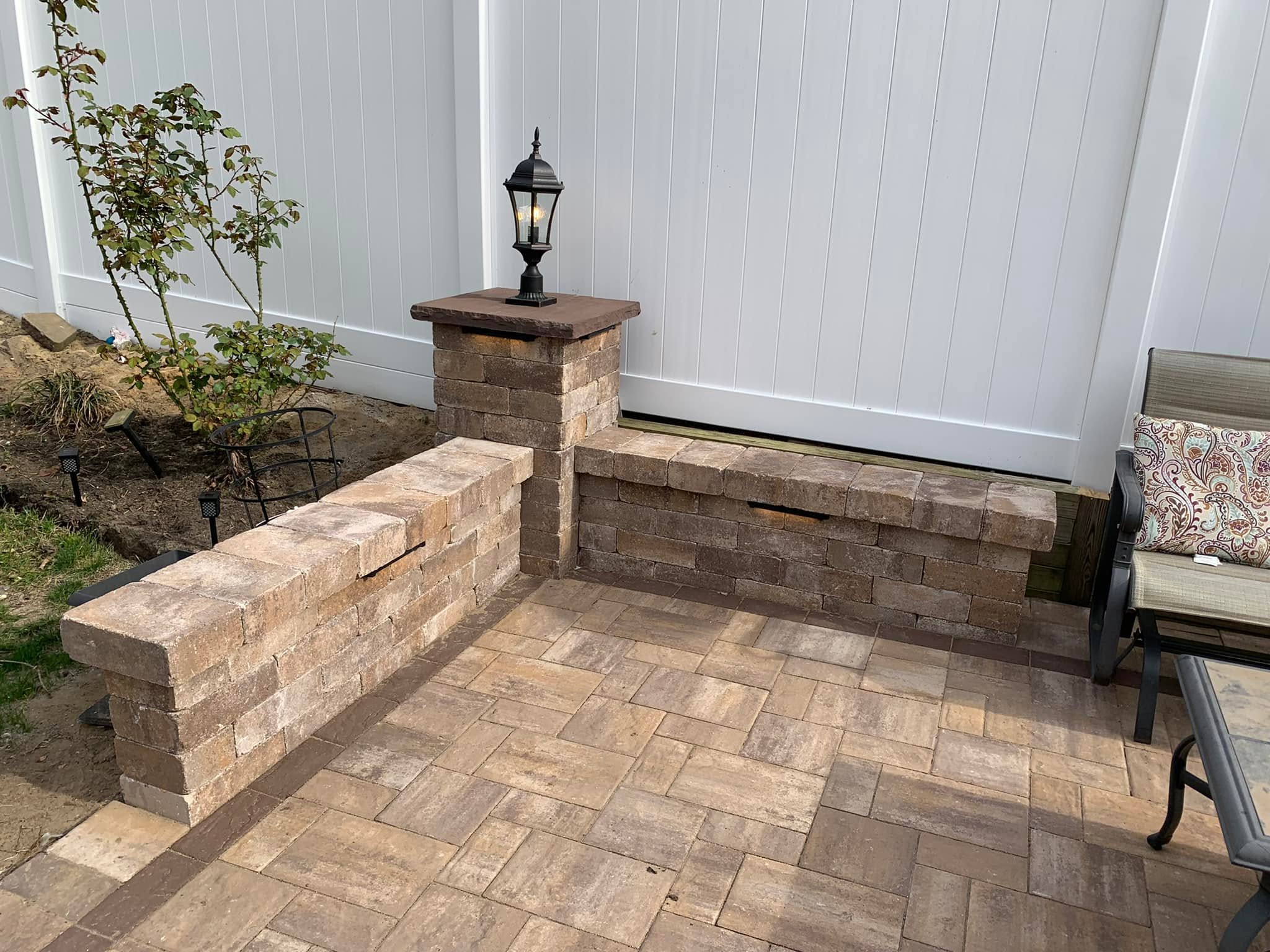
Segmental block and natural stone retaining walls across Suffolk County, built with the drainage behind them rather than just the blocks in front.
Get a free on-site estimate → · Call (631) 245-9273
A retaining wall holds back water, not just soil
This is the thing most homeowners have never been told, and it explains almost every failed wall you will ever see.
Dry soil is heavy. Saturated soil is much heavier and pushes sideways with far more force. That sideways push is what knocks walls over: a wall perfectly capable of retaining the soil behind it will still fail if the water in that soil has nowhere to go.
So the parts that matter are the ones nobody sees once it’s finished:
- Free-draining backfill immediately behind the blocks, not the excavated soil put straight back
- A drain at the base of that zone, with somewhere real to daylight
- Geotextile between the drainage stone and the soil, so soil doesn’t migrate in and clog it
- A buried base course, so the bottom can’t kick out
- A compacted levelling pad underneath
Built without those, a wall stands beautifully for two or three years and then leans. Once it leans there is no fixing it. It comes down and goes back up.
Why this matters more on the north shore
Suffolk County splits along the glacial moraines.
North shore and central ridge: Huntington, Commack, Port Jefferson, Setauket, Miller Place, Ronkonkoma. Unsorted glacial till that holds water rather than releasing it. Hydrostatic pressure builds behind walls here, and it’s where walls fail. It’s also where the ground slopes, so it’s where walls are needed most. Both at once.
South of the moraines: Medford, Holbrook, Patchogue, Sayville, Islip. Free-draining outwash sand, so the hydrostatic problem is much reduced. The thing to get right here is the compacted levelling pad, because loose sand consolidates under wall load and a wall that settles differentially opens joints and sheds caps.
Coast: Hampton Bays. Sand drains well behind the wall; salt attacks any metal in the system.
Every leaning wall we’re called to look at on the north shore is a drainage failure, not a strength failure. The blocks were fine.
Height and engineering
Above a certain retained height a wall stops being landscaping and becomes a structure. It needs engineered design. Sloping north-shore sites reach that threshold far more often than flat lots.
What we do regardless: measure the retained height at the estimate, look at what’s above and behind, and tell you whether you’re in engineered territory. A contractor quoting a tall wall without mentioning engineering is either not going to build it properly or is planning for you to find out later.
Terracing is frequently the better answer. Two shorter walls with a planted bench between them can do the same job as one tall wall, look considerably better, and stay under the threshold.
Materials
Segmental concrete block. The workhorse: engineered units that lock together, a wide range of faces, and published design tables engineers work from. Geogrid reinforcement extends into the backfill on taller walls. Techo-Bloc Pro.
Natural stone, dry-laid or mortared. More expensive, more labour, unmatched on the right property.
Boulder walls for larger grade changes on bigger lots.
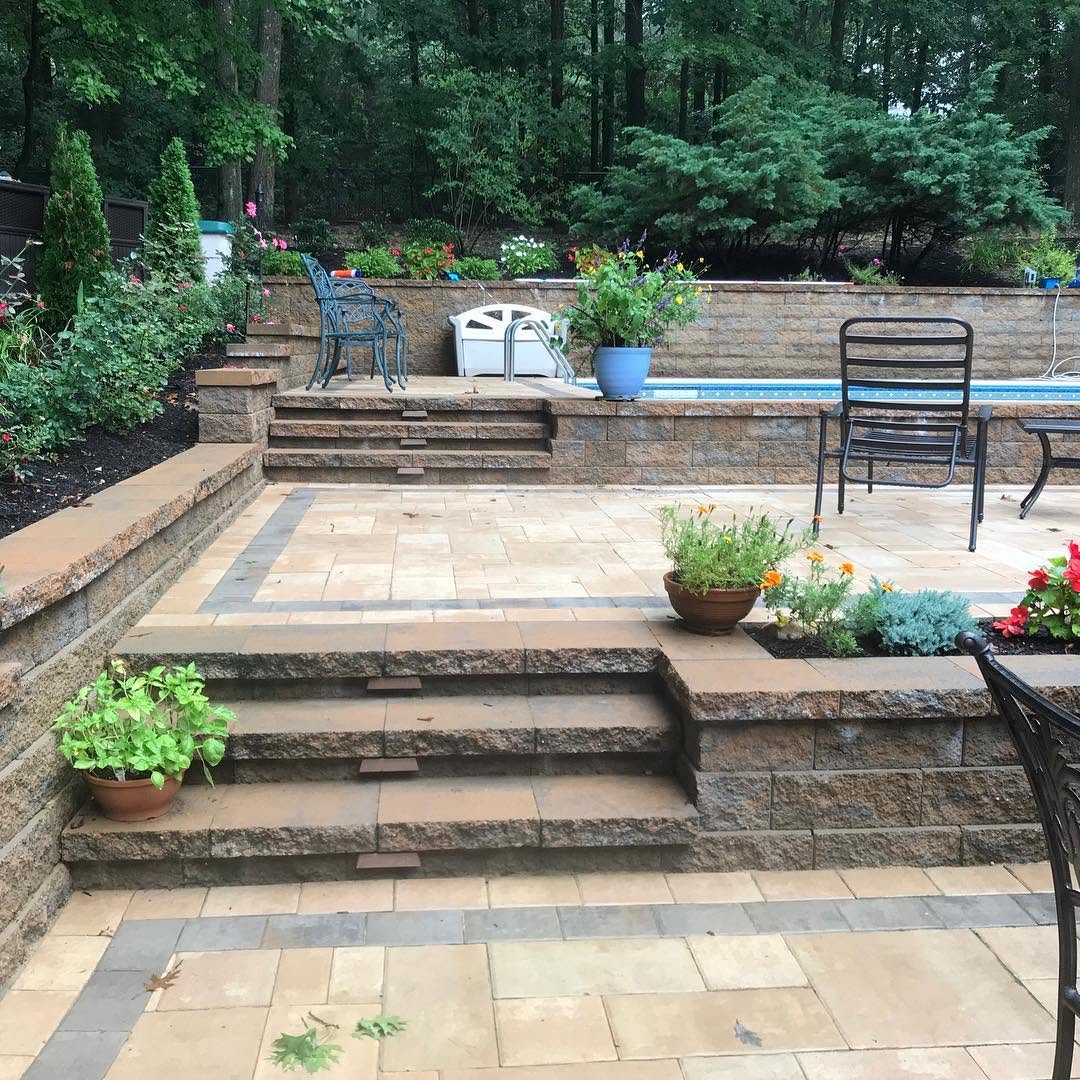
What a wall does for the rest of the yard
Most retaining wall calls start as a slope problem and end up being a usable-space conversation. A bank too steep to mow becomes a level lawn. A garden that drops away from the house becomes two usable terraces.
If a patio or seating area is also on the list, design them together: the wall sets the level everything else works to, and doing it in two phases usually means rebuilding part of the first one.
Hardscaping in Suffolk County →
Where we build
Medford · Holbrook · Ronkonkoma · Patchogue · Sayville · Islip · Setauket · Port Jefferson · Miller Place · Commack · Huntington · Hampton Bays
Book a free on-site estimate → · More about us →
Frequently asked questions
Why is my existing wall leaning? Almost always drainage. Water building up behind it with nowhere to escape pushes it forward. It can’t be pushed back. It comes down and gets rebuilt with the drainage it should have had.
Can you build over an existing wall? No. Facing over a failing wall hides the problem and adds load to a structure already losing. If the existing wall is sound it can stay; if it’s moved, it comes out.
What does it cost? It comes down to the area of wall face, the material, and what the wall is holding back. We quote on site and the estimate is free, so you get a figure for your property rather than a national average. Book one, or call (631) 245-9273 if you want to talk it through first.
Will it need maintenance? Very little if it’s drained properly. Keep the drain outlet clear and don’t plant anything with an aggressive root system directly behind it.