
Patio Installation in Suffolk County, NY
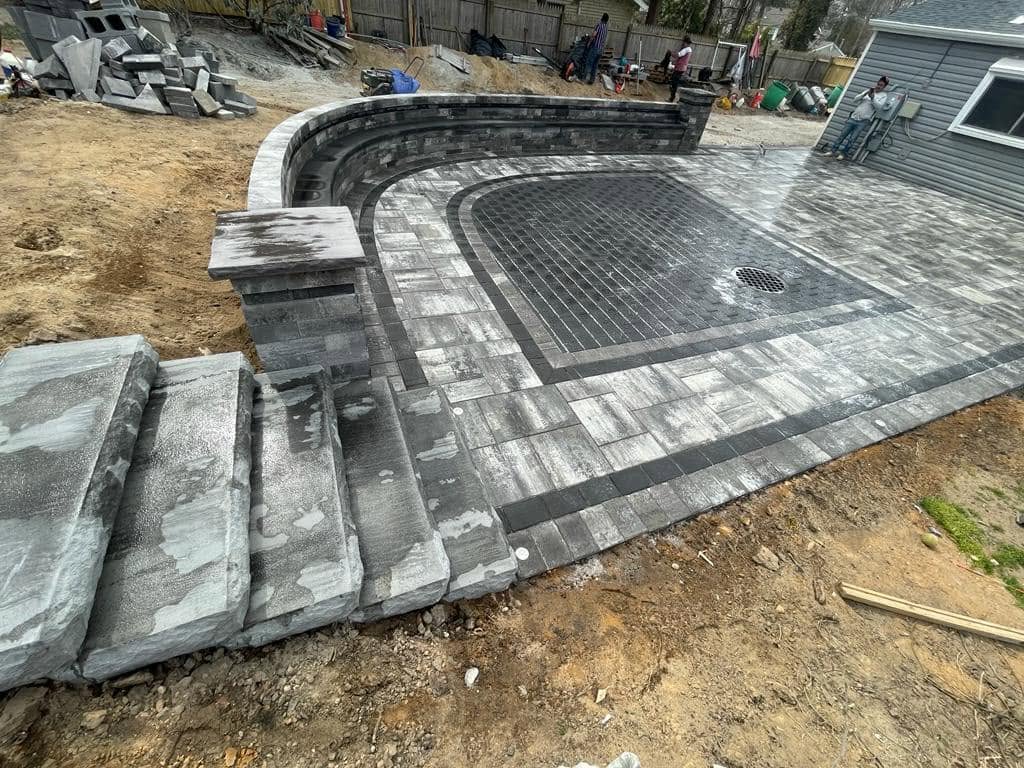
Concrete paver, natural stone and brick patios built across Suffolk County. Excavated to depth, based in compacted lifts, pitched so the water leaves, edged so the perimeter stays put.
Get a free on-site estimate → · Call (631) 245-9273
Three things decide whether a patio lasts
Not the pavers. Not the pattern. Not the brand.
Base depth and compaction. Aggregate placed in lifts with a pass at each. Full depth dumped and rolled once looks identical on handover and dishes within two years.
Pitch. Away from the house, at roughly a quarter inch per foot. Level looks better on a drawing and puddles in practice, and standing water on a Long Island patio is an ice sheet at the back door in January.
Edge restraint. Pinned into the base around the full perimeter. Without it the outer courses walk outward under load and frost, joints open across the whole field, and there is no repairing a spread patio. It gets lifted and relaid.
Everything else is preference.
The full build, layer by layer →
Two counties’ worth of ground in one county
Suffolk splits along the glacial moraines that form Long Island’s spine.
South of them, across Medford, Holbrook, Patchogue, Sayville and Islip, sorted outwash sand and gravel. Free-draining, so patios rarely sit in water. Loose, so an under-compacted base consolidates quietly and dishes.
On the moraine, across Huntington, Commack, Setauket, Port Jefferson, Miller Place and Ronkonkoma, unsorted till that holds water. Frost heave is the failure mode, and the base has to give the water a route out rather than a place to sit.
On the coast, across Hampton Bays, free-draining sand, a high water table near the water, and salt that attacks the metal in edge restraint fixings.
Same county, three specifications.
Materials
Concrete pavers: the default. Huge range, consistent dimensions, and a damaged unit lifts out and gets replaced. Techo-Bloc Pro, though we’re not tied to one manufacturer.
Natural stone: bluestone and flagging. More expensive, more labour, unmatched on the right house.
Clay brick, where it needs to match existing masonry.
On efflorescence: the white bloom on new concrete pavers is lime working out of the cement. Normal, not a defect, weathers off over the first season.
Sizing
Patios get built too small far more often than too large, because they’re drawn as a rectangle rather than measured against furniture. A dining set needs room to pull chairs fully out and for someone to walk behind a seated person. A seating group needs a route around it.
Bring us the furniture dimensions or point at what you’ve got. We set the shape out on the ground before anyone digs.
Do it with the rest of the yard
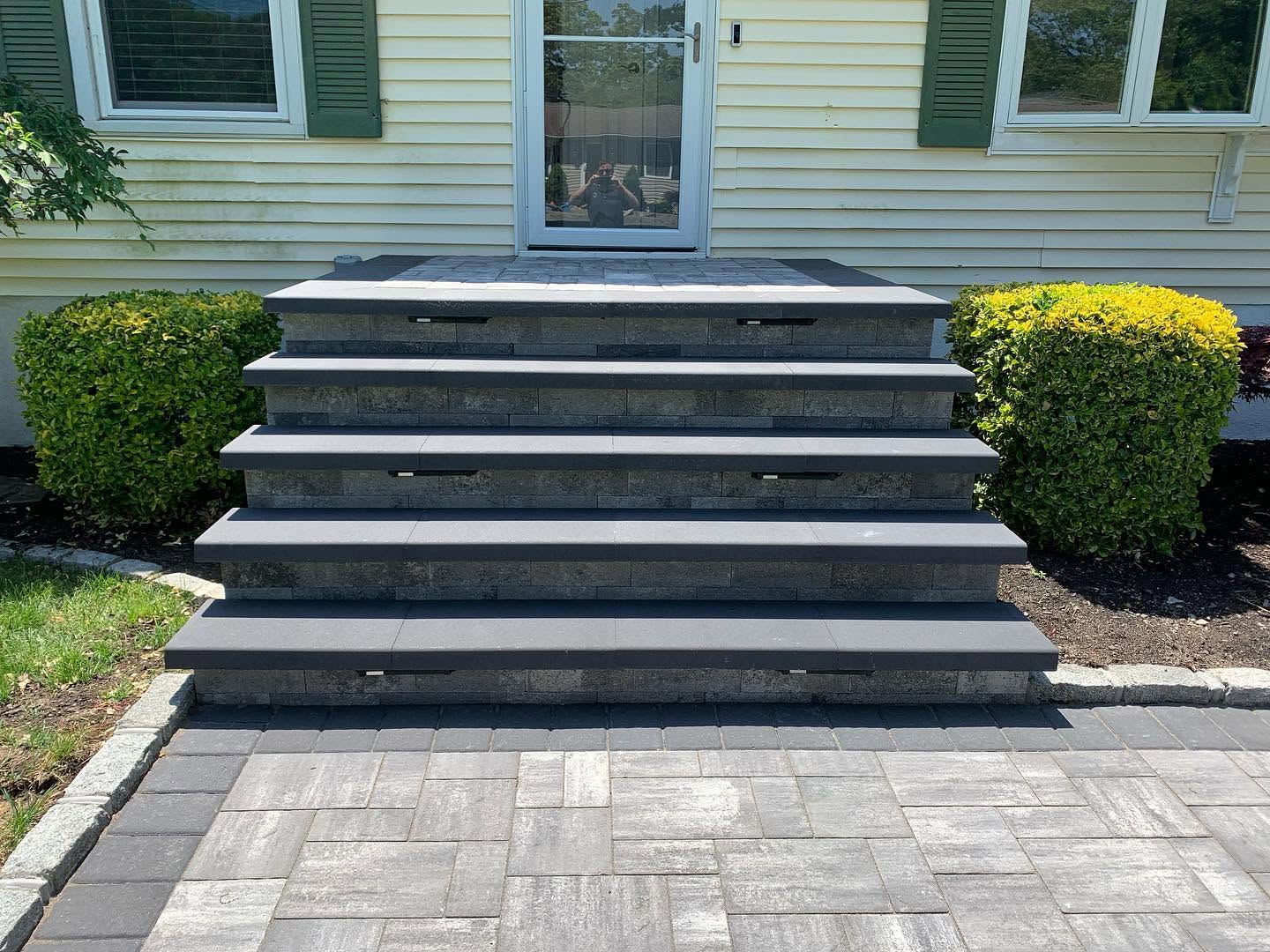
If a wall, steps, a fire pit or a kitchen are also on the list, doing them together means one excavation, one grade, one continuous base, one drainage plan and one material batch. Built in separate years the levels don’t resolve and the paver colours don’t match: concrete pavers vary between production runs and nothing fixes that afterwards.
Hardscaping in Suffolk County →
Where we build
Medford · Holbrook · Ronkonkoma · Patchogue · Sayville · Islip · Setauket · Port Jefferson · Miller Place · Commack · Huntington · Hampton Bays
Credentials
ICPI certified: the installer certification covering subgrade, base, bedding, compaction, jointing and edge restraint, which is exactly the list at the top of this page. Techo-Bloc Pro. A+ with the BBB. Not BBB accredited, which is a paid membership rather than a rating.
Book a free on-site estimate → · More about us →
Frequently asked questions
How long does a patio take? Three to five days on site for most residential patios. Most of that is excavation and base; laying the pavers is the quick part.
What does it cost? It comes down to the area, the material, and the condition of what is already there. We quote on site and the estimate is free, so you get a figure for your property rather than a national average. Book one, or call (631) 245-9273 if you want to talk it through first.
Will it settle? Properly based and compacted, no. Minor movement at the very edges over years is normal and correctable. Dishing in the middle is base failure.
Can you repair an existing patio? Often, yes. Patio repair →